Lowrider Hydraulics aka Eppie Martinez
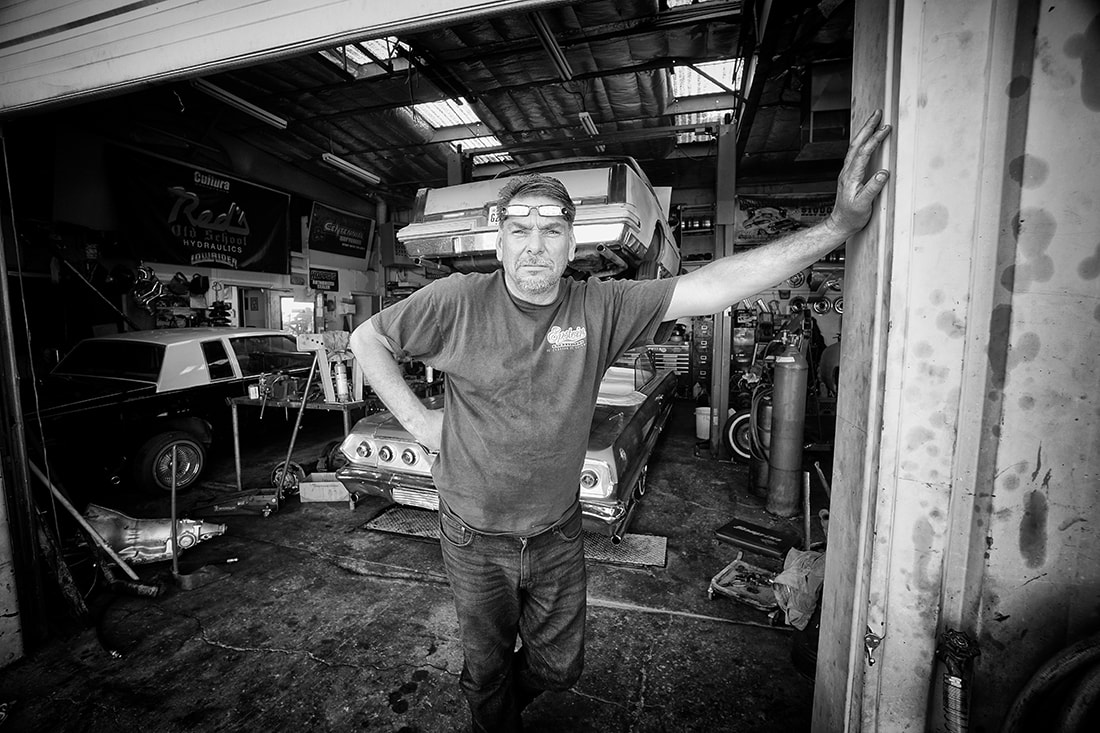
Eppie Martinez at Red's Old School in Old Town Albuquerque, New Mexico. A short while after this photo and story, Martinez moved back north to the Espanola Valley
Story and photos by Bob Eckert
Story and photos by Bob Eckert
Lowrider hydraulics came about, not because they make a car hop or ride around corners on three wheels, which admittedly are terrific benefits of the technology, but for pragmatic reasons.
“Back in the day in Chimayó you’d go through arroyos, and every arroyo would go to somebody’s house,” said Eppie Martinez, owner of Red’s Old School. “A lowrider is low — as low as you can go is the best — but if it’s that low, you ain’t getting out where you’re at. Back then we lived in arroyos and on dirt roads. It was the longest ride to get to that highway, but it was worth it. That’s just how we are, bringing that car out. That where the hydraulics came in, where you were able to rise it over ruts and rocks and speed bumps in the road to get out.”
In California, lowrider owners loved the idea of raising and lowering their cars. It was entertaining for bystanders and fun for passengers, police however were not so enthralled with the trend. That’s where Vehicle Code 24008 came in, stating it thereby illegal to operate any car modified so that any part was lower than the bottoms of its wheel rims.
As with all rules, however, there are those that feel it’s their responsibility to bend or break them, hence the use of hydraulics.
When a lowrider would see a police officer, or hear about one up ahead from other cruisers, he or she could raise the car, via the hydraulics, to make it “legal.”
Martinez explained there are two types of lifts most used today; hydraulics and air bags.
“For me, I’d use hydraulics,” Martinez admitted. “Air Ride can only do so much. But some of them can do what hydraulics can, but only for a little bit. Hydraulics can go on and on until the batteries are dead. Once the air is gone, it’s gone. Air Bags can do some crazy stuff. Back about 10 years ago they weren’t allowed because it wasn’t hydraulic. So then these guys started making these trucks do things like, ‘Oh my God.’ And a lot of the guys want the ride but they don’t want the bounciness (hard ride of the traditional ‘cut’ car as opposed to air ride) so they go with Air Ride, these little pillows here.”
Cut means putting hydraulics on it. In the street they say, “Hey, has that car ever been cut?”
An air ride suspension simply replaces coil springs with flexible, rubber, pressure-filled bags of air. These bags are inflated or deflated through a series of electrical controls as necessary, giving it a signature smooth ride.
Hydraulic suspensions raise and lower much quicker than air bag suspension because hydraulic fluid doesn’t take as long to compress. And for a longtime lowrider like Martinez, they are desired because they are traditional.
Martinez is the go-to hydraulics guy. If you mention hydraulics, Red’s or Martinez’s name will come into play. But with Red’s, Martinez has gone from just hydraulics to a full service shop: upholstery, paint, full restoration…
“My thing I tell these guys is that when they bring a car to me, I treat it like my own,” Martinez said.
“In the ‘80s during my high school days, the culture, on the Hispanic side, started to become established. Then it turned into everybody being involved. You had younger generations coming in and it became something to do. It’s really a family thing. A piece of your own art. But some of them don’t like the hydraulics,” said Martinez. “Some don’t like the idea of destroying the car. ‘I don’t want to get it cut.’”
“Back then, 10-15 years ago, if a car was cut, the car was no good” Martinez said. “But now, the cars that are cut are worth more because they are cut — if they are done right, of course. And depending where it was done.”
Martinez learned about cars primarily from his father, Ray, who was a mechanic and worked for Boeing in California before returning to Chimayó and eventually opening his own shop.
Ray was also revered in the lowriding community for his automotive knowledge.
“Going back a bit, there were no places like this (Reds Old School); there were Backyard Guys,” Martinez said. “Homies helping out a homie.
Martinez said that just like the way he learned from his father, the generations have learned to love lowriders, but with the new generation there are constant changes.
One of those changes is the hopping contests.
“Just trying to get over that Coke can back then. If you could hop over a can, you were like, ‘Wow,’” Martinez said, reminiscing about “Back in the Day,” and then shifting to the present. “It’s a whole new generation. It’s not about the amount of batteries, it’s not about the amount of metal, it’s not the size of tires or what particular vehicle anymore. Now it’s more about the weight. You look at some of these cars and they have beams instead of batteries because it’s easier to do that and quicker than trying to build something to do what they do.”
When Martinez mentions weight and beams he’s referring to basic physics.
“You’re granddaughter on a teeter totter on one side and you on the other. What’s going to happen?” he asked. “Instead of doing it the hard way like we grew up doing, they now they are trying to do it an easier way. For us, it’s not fair.”
The “easier way” meaning they are adding extra weight to the rear of the vehicle making it easier for it to tilt up on its rear wheels up or hop” higher.
He mentioned a fellow who they recently competed with who had an extended cab truck as opposed to Red’s standard size truck and in the back of the long bed was a large, heavy beam. With the longer wheelbase and weight in the back, physics took over and let the longer truck hop higher.
“Eight or nine years ago, Lowrider Magazine had this big thing about having your car standing; the truck or car staying upright after hopping.” Martinez explained. “Now, the hard part was making it come back down by itself. Before you only had one switch you were allowed and then there was the double switch, where you were sending it up and then hit another one to send it down. It’s more on the competitive side, not making it so easy.”
Essentially sponsors are trying to enhance the entertainment value of the hopping contests by lessening rules and making it easier to reach higher hops, but this comes at the expense of tradition, at least to hear Martinez.
“You can’t bring back the good old days like they say, all you can do is remember them,” Martinez said. “That was when hopping was hopping, you had rules. Now there are no rules.”
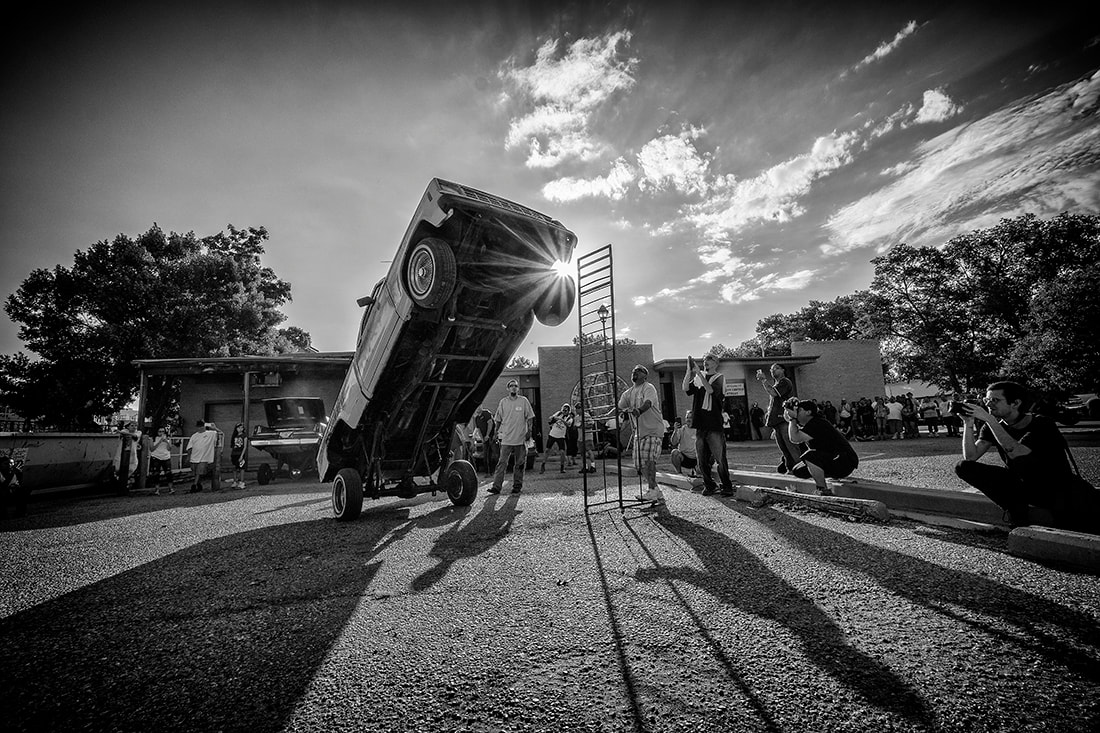
Shortly after his father Ray died, Martinez won the hopping contest held during Lowrider Day in Espanola, New Mexico. He hopped his father's car for the last time in the contest in honor of his father.

Three cars being worked on at Red's Old School

The outdoor yard at Red's (above and below)


Eppie Martinez helps carry his father's casket enroute to the funeral serice and burial
To contact Bob Eckert for assignments, consultations or workshops, please email [email protected]
or use the contact form on the About page
or use the contact form on the About page